
bionatry: July, 7, 2026
Best Home Exercises for Weight Loss: A Complete Beginner’s Guide
Best Home Exercises for Weight Loss: A Complete Beginner’s Guide
Losing weight at home has never been more accessible. With countless workout videos, fitness apps, and online programs available, almost anyone can start exercising without stepping into a gym. Yet despite this convenience, many people struggle to achieve lasting results.
The biggest obstacle is rarely motivation alone. More often, the problem is following unrealistic routines, expecting rapid changes, or relying on workouts that are not supported by scientific evidence. Sustainable weight loss requires more than simply moving more—it requires understanding how the body uses energy, how different types of exercise affect metabolism, and how to build habits that can be maintained over time.
Research consistently shows that structured home workout programs can be just as effective as gym-based training for improving body composition and supporting weight loss. In fact, many people remain more consistent when exercising at home because it removes common barriers such as travel time, expensive memberships, and crowded facilities.
This guide explains the science behind effective home workouts, explores the most efficient exercises for beginners, and provides practical strategies to help you build a routine that delivers realistic, long-term results.
Understanding How Weight Loss Really Works
Many fitness trends promise quick transformations, but the biological process behind weight loss remains surprisingly straightforward.
Body weight changes according to energy balance. When your body uses more calories than it receives from food and beverages, it gradually turns to stored fat to meet its energy needs. This is known as a calorie deficit.
Daily calorie expenditure comes from three primary sources.
Basal Metabolic Rate (BMR)
Basal metabolic rate represents the energy your body needs simply to stay alive. Breathing, circulating blood, maintaining body temperature, and supporting organ function all require energy, even while you sleep.
For most adults, BMR accounts for approximately 60–70% of total daily calorie expenditure, making it the largest contributor to overall energy use.
The Thermic Effect of Food (TEF)
Digesting, absorbing, and processing nutrients also burns calories. This process typically contributes around 10% of total daily energy expenditure.
Protein-rich foods generally require more energy to digest than carbohydrates or fats, which is one reason higher-protein diets may help support weight management.
Physical Activity
Exercise and everyday movement make up the remaining portion of daily calorie expenditure.
This includes:
- Planned workouts
- Walking
- Household chores
- Taking the stairs
- Gardening
- Recreational activities
Although physical activity represents a smaller percentage than BMR, it is the factor you can influence most directly.
Most experts recommend combining moderate calorie reduction with increased physical activity to create a sustainable calorie deficit rather than relying on either strategy alone.
Why Exercise Matters Beyond Burning Calories
Many beginners believe exercise is valuable only because it burns calories during a workout.
In reality, regular exercise provides benefits that extend far beyond immediate calorie expenditure.
It Helps Preserve Lean Muscle
Weight loss often results in losing both fat and muscle. Resistance training signals the body to preserve muscle tissue while reducing body fat.
Maintaining muscle is important because muscle tissue remains metabolically active, requiring more energy than fat tissue even at rest.
It Supports Long-Term Metabolism
Although strength training does not dramatically increase metabolism overnight, maintaining healthy muscle mass helps prevent the metabolic slowdown that often accompanies significant weight loss.
This makes long-term weight maintenance easier.
It Improves Overall Health
Regular exercise has been associated with numerous health benefits, including:
- Better cardiovascular health
- Improved blood sugar regulation
- Enhanced mood
- Better sleep quality
- Increased mobility
- Stronger bones
- Reduced risk of chronic diseases
These improvements often appear before major physical changes become visible.
The Three Most Effective Types of Home Exercise
Health organizations consistently recommend combining multiple forms of exercise instead of relying on only one.
An effective beginner program typically includes:
- Strength training
- Cardiovascular exercise
- High-Intensity Interval Training (HIIT)
Each contributes differently to weight loss and overall fitness.
Strength Training: The Foundation of Fat Loss
One of the biggest misconceptions is that strength training is only for athletes or bodybuilders.
In reality, resistance exercise is one of the most valuable tools for beginners trying to lose weight.
Current exercise guidelines emphasize that even simple bodyweight movements performed consistently can significantly improve strength, mobility, and body composition.
The goal is not lifting heavy weights immediately.
Instead, beginners should focus on learning proper movement patterns while gradually increasing difficulty.
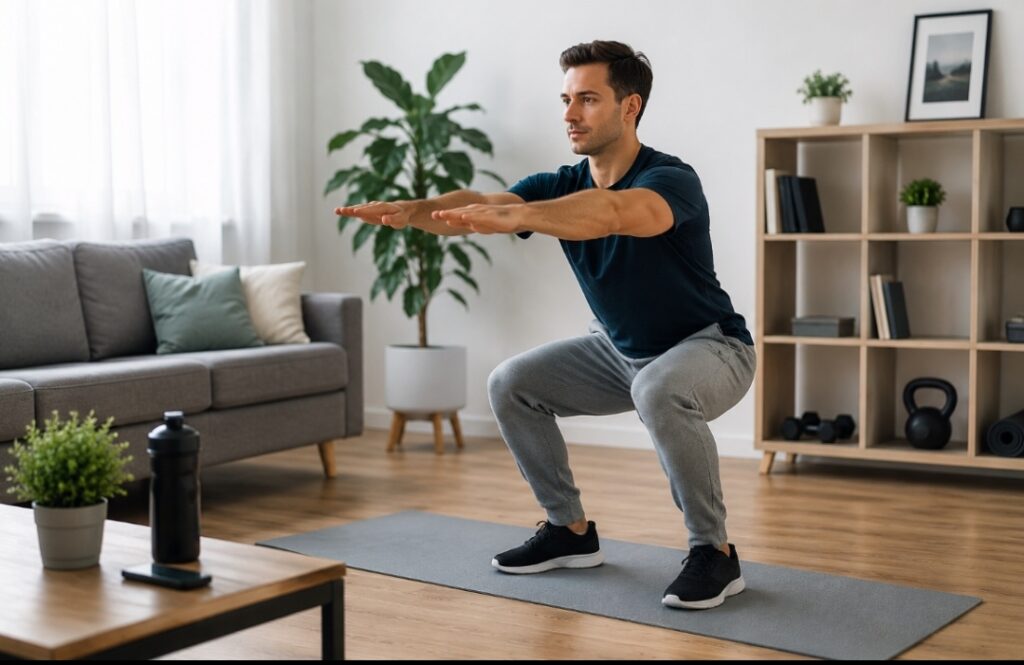
1. Bodyweight Squats
Squats strengthen several of the body’s largest muscle groups, including:
- Glutes
- Quadriceps
- Hamstrings
- Core
Because these muscles require substantial energy to work, squats can contribute meaningfully to overall calorie expenditure.
Beginner tip: Start by sitting back toward a sturdy chair before progressing to full bodyweight squats.
2. Push-Ups
Push-ups develop strength throughout the upper body while also engaging the core.
They target:
- Chest
- Shoulders
- Triceps
- Abdominal muscles
Modified push-ups performed against a wall or from the knees provide an excellent starting point.
Proper technique is far more important than completing many repetitions.
3. Planks
Planks improve core stability without placing unnecessary stress on the spine.
A stronger core supports better posture, improves balance, and makes many everyday movements easier.
Beginners can start by holding the position for 15–20 seconds before gradually increasing duration.
4. Lunges
Lunges strengthen the legs while improving balance and coordination.
Because each leg works independently, lunges also help identify and correct muscle imbalances.
Move slowly and maintain proper knee alignment throughout each repetition.
Sample Beginner Strength Routine
| Exercise | Sets | Repetitions |
|---|---|---|
| Squats | 2–3 | 10–12 |
| Push-Ups | 2–3 | 8–12 |
| Lunges | 2–3 | 8–10 each leg |
| Planks | 2–3 | 20–30 seconds |
Rest for approximately one minute between exercises.
Cardio: Increasing Daily Energy Expenditure
Cardiovascular exercise remains one of the most effective ways to burn calories while improving heart and lung health.
Health experts generally recommend at least 150 minutes of moderate-intensity aerobic activity per week, though additional activity may provide greater weight-management benefits.
Fortunately, effective cardio workouts require little or no equipment.
Brisk Walking
Walking remains one of the safest and most sustainable forms of exercise.
Whether outdoors, on a treadmill, or simply marching in place indoors, regular walking can substantially increase daily calorie expenditure.
Many people benefit from gradually increasing daily movement toward 8,000–10,000 steps.
Jump Rope
Jumping rope delivers an impressive cardiovascular workout in a short amount of time.
It improves:
- Coordination
- Balance
- Cardiovascular endurance
- Lower-body power
Because it is relatively intense, beginners should alternate short work intervals with recovery periods.
For example:
- 30 seconds jumping
- 30–60 seconds resting
Repeat several rounds according to fitness level.
Stair Climbing
If stairs are available, they provide an excellent home workout.
Climbing stairs challenges the heart while strengthening:
- Glutes
- Quadriceps
- Calves
Even short sessions performed consistently can improve cardiovascular fitness.
Jumping Jacks
Jumping jacks are a classic full-body exercise that quickly elevates heart rate.
They require no equipment and fit easily into almost any home workout.
Beginners who experience joint discomfort can perform a low-impact version by stepping one foot out at a time instead of jumping.
High-Intensity Interval Training (HIIT)
For individuals seeking maximum efficiency, HIIT offers an excellent option.
HIIT alternates short bursts of vigorous exercise with brief recovery periods.
One reason HIIT has attracted significant scientific interest is its ability to deliver meaningful cardiovascular and metabolic benefits in relatively short workouts.
The intense effort also increases post-exercise oxygen consumption (EPOC), meaning the body continues using additional energy during recovery after the workout ends.
Although HIIT is highly effective, beginners should approach it gradually.
Proper technique should always take priority over speed.
Beginner HIIT Session (15–20 Minutes)
Warm-Up (3 minutes)
- March in place
- Arm circles
- Dynamic leg swings
Workout Circuit
Complete four rounds:
- 30 seconds Jumping Jacks
- 30 seconds Rest
- 30 seconds Mountain Climbers
- 30 seconds Rest
- 30 seconds Bodyweight Squats
- 30 seconds Rest
Cool-Down (3 minutes)
Finish with gentle stretching for the legs, hips, chest, shoulders, and back.
Cooling down helps gradually lower heart rate while supporting flexibility and recovery.
Part 2
Common Mistakes That Slow Weight Loss Progress
Starting a home fitness routine is an important step, but long-term success depends on avoiding common mistakes that can limit results or increase the risk of injury. Many beginners assume that working harder always produces faster progress. In reality, consistency and gradual improvement matter far more than intensity alone.
1. Doing Too Much Too Soon
One of the most common mistakes is beginning with workouts that are far beyond your current fitness level.
Long, exhausting sessions often lead to excessive muscle soreness, fatigue, and loss of motivation. In some cases, they may also increase the risk of strains or overuse injuries.
Instead, begin with manageable workouts lasting around 20–30 minutes, performed three times per week. As your endurance and strength improve, gradually increase either the duration, intensity, or frequency—but avoid changing everything at once.
Remember that sustainable habits consistently outperform short bursts of extreme effort.
2. Skipping Warm-Ups and Cool-Downs
Many people are eager to begin exercising and overlook the importance of warming up.
A proper warm-up prepares the muscles and joints for movement, increases circulation, and gradually raises heart rate. It can also improve exercise performance and reduce the likelihood of injury.
An effective warm-up may include:
- Marching in place
- Arm circles
- Hip rotations
- Leg swings
- Light bodyweight squats
Cooling down is equally valuable. Spending a few minutes stretching after exercise helps the body transition back to a resting state and may reduce post-workout stiffness.
3. Relying Only on Cardio
Cardio workouts burn calories efficiently, but performing only aerobic exercise may not be the most effective long-term strategy.
Strength training helps preserve lean muscle mass during weight loss. Maintaining muscle supports physical function and contributes to a healthier metabolism.
For most beginners, combining resistance exercises with cardiovascular training provides a more balanced and sustainable approach than focusing on either one alone.
4. Not Eating Enough Protein
Nutrition plays an essential role in body composition.
Protein helps maintain muscle tissue during a calorie deficit while also increasing feelings of fullness after meals.
Although individual needs vary depending on age, body size, activity level, and health status, many active adults benefit from distributing protein evenly across meals throughout the day.
Whole-food protein sources include:
- Chicken
- Fish
- Eggs
- Greek yogurt
- Beans
- Lentils
- Tofu
- Cottage cheese
If you have a medical condition or specific dietary needs, consult a qualified healthcare professional or registered dietitian for personalized guidance.
5. Expecting Immediate Results
Modern social media often creates unrealistic expectations.
Visible physical changes rarely occur within a few days.
Most beginners notice improvements in:
- Energy levels
- Exercise confidence
- Strength
- Balance
- Endurance
within the first few weeks.
Noticeable changes in body composition generally require several weeks or months of consistent exercise, balanced nutrition, adequate sleep, and patience.
Healthy progress is gradual—and gradual progress is more likely to last.
Simple Equipment That Can Increase Workout Variety
One of the greatest advantages of home exercise is that very little equipment is required.
Bodyweight exercises alone can provide excellent results for beginners. However, inexpensive household items can add variety and gradually increase resistance as strength improves.
| Fitness Equipment | Household Alternative | Practical Tips |
|---|---|---|
| Light dumbbells | Filled water bottles | Easy to grip and ideal for shoulder or arm exercises. |
| Medium weights | Laundry detergent container or water jug | Ensure the container is securely closed before use. |
| Medicine ball | Backpack filled with books | Adjust the weight gradually to suit your ability. |
| Step platform | Stable staircase or sturdy step | Use only on secure, non-slip surfaces. |
| Resistance bands | Towel for mobility exercises | Useful for stretching but not a complete replacement for resistance bands. |
While equipment can add variety, it should never become a barrier to getting started. Consistency is far more important than owning expensive fitness gear.
A Beginner-Friendly Weekly Workout Plan
An effective weekly schedule balances exercise with adequate recovery.
Recovery allows muscles to repair, adapt, and become stronger, making rest an important part of every fitness program.
Monday
- Full-body strength workout (20–30 minutes)
- 30-minute brisk walk
Tuesday
- 40–45 minutes of moderate walking
- Gentle stretching
Wednesday
- Beginner HIIT session (20 minutes)
- Easy walk for 15–20 minutes
Thursday
- Brisk walking
- Mobility and flexibility exercises
Friday
- Full-body strength training
- 30-minute walk
Saturday
Choose an enjoyable activity such as:
- Hiking
- Dancing
- Cycling
- Swimming
- Recreational sports
- Long outdoor walk
Making physical activity enjoyable increases the likelihood of maintaining healthy habits over time.
Sunday
Recovery day.
Consider:
- Gentle stretching
- Light yoga
- Relaxed walking
- Deep breathing exercises
Rest is productive because it supports recovery and prepares your body for the coming week.
Practical Tips for Long-Term Success
Small habits often produce the greatest long-term results.
Schedule Your Workouts
Treat exercise like any other important appointment by assigning it a consistent time each day.
Many people find morning workouts easier to maintain because fewer unexpected responsibilities interfere later in the day.
Track Your Progress
Success isn’t measured only by the number on the scale.
Consider recording:
- Workout completion
- Exercise repetitions
- Walking distance
- Energy levels
- Sleep quality
- Waist measurements
Looking back at previous achievements can provide motivation during periods when progress feels slow.
Exercise With Others
Working out with family members or friends can make exercise more enjoyable while increasing accountability.
Even virtual workout partners or online fitness communities may help maintain consistency.
Listen to Your Body
Some muscle soreness is normal when beginning a new program.
However, sharp pain, dizziness, chest discomfort, or unusual shortness of breath should never be ignored.
If symptoms persist or you have an existing medical condition, seek advice from a qualified healthcare professional before continuing your exercise program.
Digital Tools That Can Help You Stay Consistent
Many beginners benefit from structured workout programs that remove the guesswork from exercise planning.
Popular fitness platforms such as Nike Training Club and Daily Burn offer guided workouts for different experience levels, often requiring little or no equipment.
These resources can provide:
- Step-by-step instruction
- Progressive workout plans
- Built-in motivation
- Exercise demonstrations
- Flexible training schedules
While digital tools can be helpful, remember that no app replaces consistency, realistic expectations, and healthy lifestyle habits.
Based on the information discussed above, some individuals include dietary supplements as part of a broader weight-management approach. These products are meant to complement balanced nutrition, regular physical activity, and other healthy lifestyle habits that support long-term well-being.
✅ Keto-Friendly Supplement for Weight Management Support
Start your weight-management journey with NuviaLab Keto, a dietary supplement designed to complement a ketogenic lifestyle. Its carefully selected ingredients are intended to support fat metabolism, help manage cravings, and maintain natural energy levels throughout the day. It may also help ease the transition into ketosis, making the keto lifestyle more comfortable to follow. When combined with healthy eating habits and regular activity, it can be a convenient addition to your daily routine.
Products are chosen independently by us. Purchases made through our links may earn us a commission at no additional cost to you.
Frequently Asked Questions
What are the best home exercises for weight loss?
A balanced combination of bodyweight strength exercises, moderate cardiovascular activity, and beginner-friendly HIIT workouts provides one of the most effective approaches for improving fitness and supporting fat loss.
How many days per week should beginners exercise?
Most health organizations recommend at least 150 minutes of moderate-intensity physical activity each week, combined with muscle-strengthening exercises on two or more days.
Beginners should increase activity gradually according to their fitness level.
Can I lose weight without gym equipment?
Yes.
Bodyweight exercises such as squats, push-ups, lunges, planks, and walking can effectively improve strength, fitness, and calorie expenditure without specialized equipment.
How long does it take to see results?
Many people notice improvements in energy, strength, and endurance within several weeks.
Visible changes in body composition typically require consistent exercise, balanced nutrition, and patience over a longer period.
Is walking enough for weight loss?
Walking can support weight loss, particularly when combined with a calorie-controlled eating pattern.
For even better long-term results, combine walking with strength training to help maintain muscle mass and improve overall fitness.
Final Thoughts
Losing weight at home does not require expensive equipment, complicated workout routines, or extreme exercise programs.
The most effective approach combines regular movement, progressive strength training, cardiovascular exercise, balanced nutrition, quality sleep, and realistic expectations.
Instead of searching for the perfect workout, focus on building habits that you can maintain for months and years. Every workout completed, every healthy meal chosen, and every step taken contributes to meaningful progress over time.
Sustainable weight loss is rarely about perfection—it is about consistency.
Author Bio
R Hallou is a health and nutrition writer at Bionatry, specializing in evidence-based articles on weight management, healthy living, dietary supplements, and sustainable lifestyle strategies. His work focuses on translating scientific research into practical guidance that helps readers make informed decisions about their health and long-term wellness.https://www.bionatry.com